Stated as at 18 November 2026. The new FRS 102 lease rules are now in force for accounting periods beginning on or after 1 January 2026. Take advice on your own circumstances before acting.
FRS 102 leases now go on the balance sheet: tenants must show most leases as a right-of-use asset and a matching lease liability, instead of a simple rent charge. The rules are in Section 20 of FRS 102 and apply from your first accounting period beginning on or after 1 January 2026. They are one part of a wider update covered in our FRS 102 guide.
Key points
- Small companies using Section 1A apply the new lease rules in full. Micro-entities on FRS 105 keep leases off the balance sheet.
- Leases with a lease term of 12 months or less, and leases of low-value items such as laptops, can stay off. Cars, vans and property are never low value.
- Last year’s figures are not restated.
- The cash you pay doesn’t change, but the costs do. In our hypothetical premises example, the first-year charge rises from £60,000 to £69,864.
What has changed in FRS 102 lease accounting?
For tenants (the lessee, in the standard’s terms), the split between operating leases (off the balance sheet) and finance leases has gone. When a lease starts, you now recognise two things:
- a right-of-use asset: your right to use the property, vehicle or equipment, shown as an asset and depreciated;
- a lease liability: the payments you are committed to, discounted to today’s value (their present value).
In the profit and loss account, rent is replaced by depreciation and interest. Interest is worked out on the falling liability, so the total charge is higher in the early years and lower later. The cash you pay stays the same. To find out which of your leases come on to the balance sheet, send us your list of leases.
FRS 102 leases: who is affected?
Every company on FRS 102 that rents property, vehicles or equipment, small companies included. Micro-entities and landlords are the main exceptions.
- Small companies using Section 1A: the rules apply in full. Section 1A cuts what you present and disclose, not how you measure. It also adds notes, including a description of your significant leases: see what small company accounts must now disclose.
- Micro-entities on FRS 105: no change, because FRS 105’s lease section was not amended. A company that leaves FRS 105, by choice or by outgrowing the micro limits, would pick up these rules (see choosing between the micro and small standards).
- Landlords: largely unchanged. They still classify each lease as finance or operating.
What counts is when your period begins. The FRC’s example is a 31 March year end: its first year under the new rules ends on 31 March 2027.
What counts as a lease?
In broad terms, a contract is likely to be a lease if it gives you control over the use of a specific, identified asset for a period, in return for payment. Premises, vans, cars and machinery are the usual examples.
Some arrangements are not leases. ACCA’s guidance says a serviced office is often a licence or service contract, where the provider can move you to different space. Check yours with us.
Where a lease includes services, such as vehicle maintenance, you can choose by class of asset not to split them out.
Which leases can stay off the balance sheet?
Short-term leases and leases of low-value assets. Their payments are charged as an expense, usually evenly over the lease, much as rent is today.
Short-term: a lease term of 12 months or less at the start. A lease with an option to buy never qualifies. You choose this by class of asset.
Low value: judged by the asset itself, not by your payments or by what is material to you. FRS 102 sets no £ limit. You choose lease by lease.
- Never low value: cars, vans, trucks and lorries; forklifts, telehandlers, cranes and excavators; tractors; boats and aircraft; land and buildings; production line equipment.
- Can be low value: laptops, desktops and tablets, mobile phones, small office furniture.
An asset you sublet can’t be low value. The FRC expects its test, wider than the one in IFRS 16 (the international standard), to keep more leases off the balance sheet. Small companies still disclose their short-term and low-value lease payments.
How is the lease liability worked out?
It is the present value of the payments not yet made: each future payment discounted at an interest rate. Choosing the rate is the main judgement.
- Use the rate implicit in the lease if you can readily determine it.
- If not, choose lease by lease between your incremental borrowing rate (to borrow enough for a similar asset, with similar security) and your obtainable borrowing rate.
The obtainable borrowing rate is new to FRS 102 and is not in IFRS 16. It is the rate you would pay to borrow an amount like the total lease payments over a similar term. The FRC added it because it should be simpler for smaller companies to find, for example from a bank quote.
The FRC’s own illustration, put into pounds, has rent of £10,000 a year in arrears for five years. A bank quote of 7% gives a liability of £41,002. Over the lease, interest of £8,998 plus depreciation of £41,002 equals the £50,000 paid.
The right-of-use asset starts at the liability, plus payments made before the start, initial direct costs and estimated restoration costs, less any incentives received.
The lease term counts too. In the FRC’s examples, a tenant reasonably certain to extend counts the extra years, and one reasonably certain not to use a break clause counts the full term.
Worked example: a premises lease and three vans
An existing premises lease can add hundreds of thousands of pounds to both sides of the balance sheet, and push the first-year charge above the rent. This hypothetical example assumes:
- rent of £60,000 a year, paid yearly in arrears;
- 8 years left at the start of the first year under the new rules;
- a 7% rate, as an illustrative bank quote (the obtainable borrowing rate);
- no prepaid or accrued rent, so the asset starts equal to the liability;
- equal depreciation each year.
On day one, the liability and the right-of-use asset are £358,278 each. The rent still to pay is £480,000; the difference is future interest.
In year 1, depreciation of £44,785 plus interest of £25,079 gives a charge of £69,864, against rent of £60,000. Profit before tax is £9,864 lower. At the year end the liability is £323,357 and the asset £313,493, so net assets are £9,864 lower too. EBITDA (earnings before interest, tax, depreciation and amortisation) is £60,000 higher, because rent no longer counts against it.
| Year | Old rules: rent (£) | Depreciation (£) | Interest (£) | New rules: total (£) | Liability at year end (£) |
|---|---|---|---|---|---|
| 1 | 60,000 | 44,785 | 25,079 | 69,864 | 323,357 |
| 2 | 60,000 | 44,785 | 22,635 | 67,420 | 285,992 |
| 3 | 60,000 | 44,785 | 20,019 | 64,804 | 246,012 |
| 4 | 60,000 | 44,785 | 17,221 | 62,006 | 203,233 |
| 5 | 60,000 | 44,785 | 14,226 | 59,011 | 157,459 |
| 6 | 60,000 | 44,785 | 11,022 | 55,807 | 108,481 |
| 7 | 60,000 | 44,785 | 7,594 | 52,378 | 56,075 |
| 8 | 60,000 | 44,785 | 3,925 | 48,710 | 0 |
| Total | 480,000 | 358,278 | 121,722 | 480,000 | nil |
Over the 8 years the total is £480,000 either way. The new charge is above the rent for four years and below it from year 5.
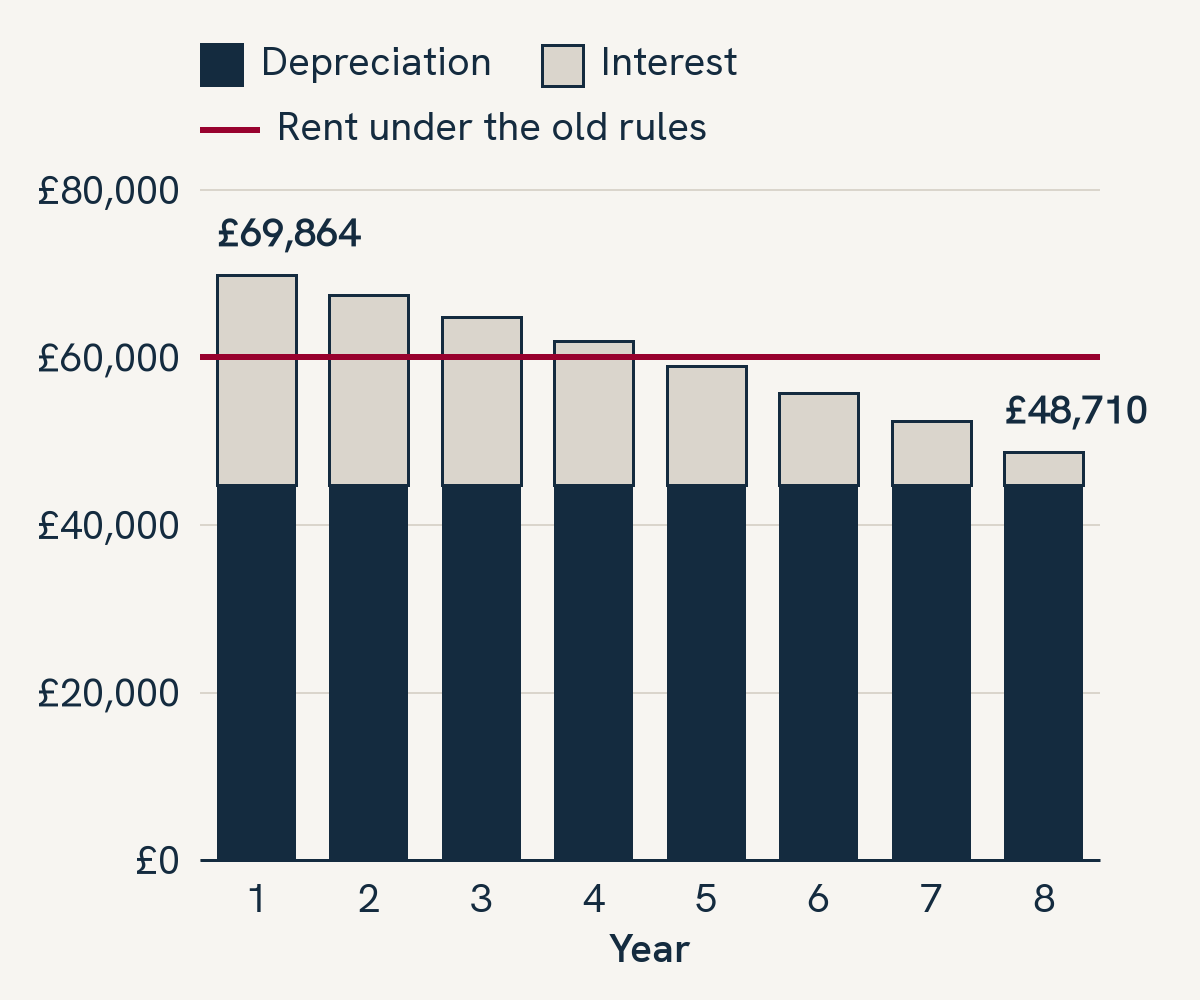
The rate matters. On the same lease, the day-one liability would be £387,793 at 5%, £372,588 at 6%, £358,278 at 7% and £344,798 at 8%.
Adding three vans
Now add three vans at £21,600 a year in total, with 3 years left, on the same assumptions. Vans are never low value. The liability is £56,685, and year 1 brings depreciation of £18,895 plus interest of £3,968.
Together, the premises and vans add £414,963 to assets and to liabilities on day one. For the size tests, the balance sheet total is total assets, with nothing deducted for the lease liability. The test uses year-end figures, so in our example the right-of-use assets count at £351,283 after a year’s depreciation. A company near the £7.5 million small limit could cross it, though one test alone doesn’t change your size: see how leases affect your company size.
What happens in your first year under the new rules?
You don’t restate last year’s figures. The comparative year stays on the old basis, and any cumulative effect goes to opening retained earnings (the profits kept in the company) on the first day of the new year.
For each former operating lease, the liability is the present value of the remaining payments on that day, at your incremental or obtainable borrowing rate. The asset equals the liability, adjusted for any prepaid or accrued rent, and is checked for impairment (whether it is worth less than its book value).
Reliefs help. You don’t have to reassess whether existing contracts are leases (you disclose that you used this relief). You can use one rate for a group of similar leases, treat leases ending within 12 months of that first day as short-term, and use hindsight on lease terms.
Because the asset starts equal to the liability, in most cases we would expect the day-one effect on reserves to be nil or small. It can be larger if an asset is impaired or a subsidiary uses its group’s IFRS 16 figures. Check your figures with us before relying on this, especially before a dividend.
What if the director or their pension scheme owns the premises?
We would expect the lease to come on to the balance sheet like any other. We are not aware of any exemption for a lease because the landlord is connected to the company.
That covers property owned by a director personally, or by a director’s pension scheme, such as a small self-administered scheme (SSAS) or a self-invested personal pension (SIPP). The same steps apply: term, payments and rate.
It is also likely to be a related party transaction. Section 1A now sets out related party disclosures for small companies, so in most cases we would expect the lease to need a note. If there is no written lease, or the rent changes from year to year, the term and payments will need careful judgement: talk to us before your year end.
What about hire purchase and existing finance leases?
Existing finance leases carry over at the amounts already in your accounts. Vehicles on hire purchase are usually on your balance sheet already, so we would expect little change for them; check with us if you are unsure.
The vehicles that change are those previously treated as operating leases, which in most cases means contract hire.
What should you do now?
Gather the lease information before your year end.
- List every lease, and anything that might be one.
- Collect the terms: dates, payments, break and extension options, rent review dates, rent-free periods and any obligation to restore the premises.
- Decide on the exemptions and choose a rate: a bank quote to borrow a similar amount over a similar term is the FRC’s own example.
- Check your loan agreements: our guide on covenants, dividends and tax goes through this.
Same cash, different numbers
The FRC says that gearing, interest cover, current ratio and EBITDA may all change, and that some companies may want to renegotiate bank covenants. Read your loan agreement before your first accounts under the new rules are drawn up, not after.
Questions clients ask
Is there a £ limit for a low-value asset under FRS 102?
No. FRS 102 sets no £ figure, and the size of your payments doesn’t decide it. Laptops, phones and small office furniture can qualify; cars, vans, forklifts and property never do.
Does a 12-month equipment hire count as short-term?
Yes, if it has no option to buy. The test is a lease term of 12 months or less at the start, so exactly 12 months qualifies.
Will the lease change affect our corporation tax?
Relief generally follows the accounts. For most leases HMRC accepts depreciation plus lease interest as the deductible amount, though some capital items are added back. HMRC’s guidance indicates that transition adjustments are spread over the remaining lease terms, and it expects fewer of them under FRS 102.
We are a micro-entity. Do we need to do anything?
Not for leases, while you stay on FRS 105: its lease rules did not change. If you move to FRS 102 or outgrow the micro limits, the new lease rules would apply.
Can we use one discount rate for all our vans?
For leases you already have when the new rules start, yes: one rate can cover a group of similar leases. After that, the rate is chosen lease by lease.
Speak to us. If you would like help building your lease schedule for your first accounts under the new rules, call us on 0161 832 4451 or send us a message. We are independent chartered accountants in Manchester; see our accounts and accounting support.
More in our FRS 102 guide
- FRS 102: the 2026 changes explained
- The new five-step model for revenue
- What changes for small companies
- Micro-entity accounts or FRS 102?
- Company size limits from April 2025
- EBITDA, bank covenants, dividends and tax
Sources
- FRC: FRS 102, the standard and its amendments
- FRC staff: Factsheet 11, Lease accounting for lessees (November 2024)
- FRC staff: Factsheet 9, Initial application of the Periodic Review 2024 amendments (re-issued May 2026)
- FRC: FRS 102 explainer for users of accounts (June 2026)
- ACCA In Practice: FRS 102 lease changes (March 2026)
- HMRC Business Leasing Manual BLM51005: lease expense deduction
- HMRC Business Leasing Manual BLM52005: spreading of transition adjustments
- Companies Act 2006 section 382: qualifying as a small company