
Stated as at 18 November 2026. The new FRS 102 rules are now in force for accounting periods beginning on or after 1 January 2026, and the Companies House position reflects the government’s announcement of 23 October 2026. Take advice on your own circumstances before acting.
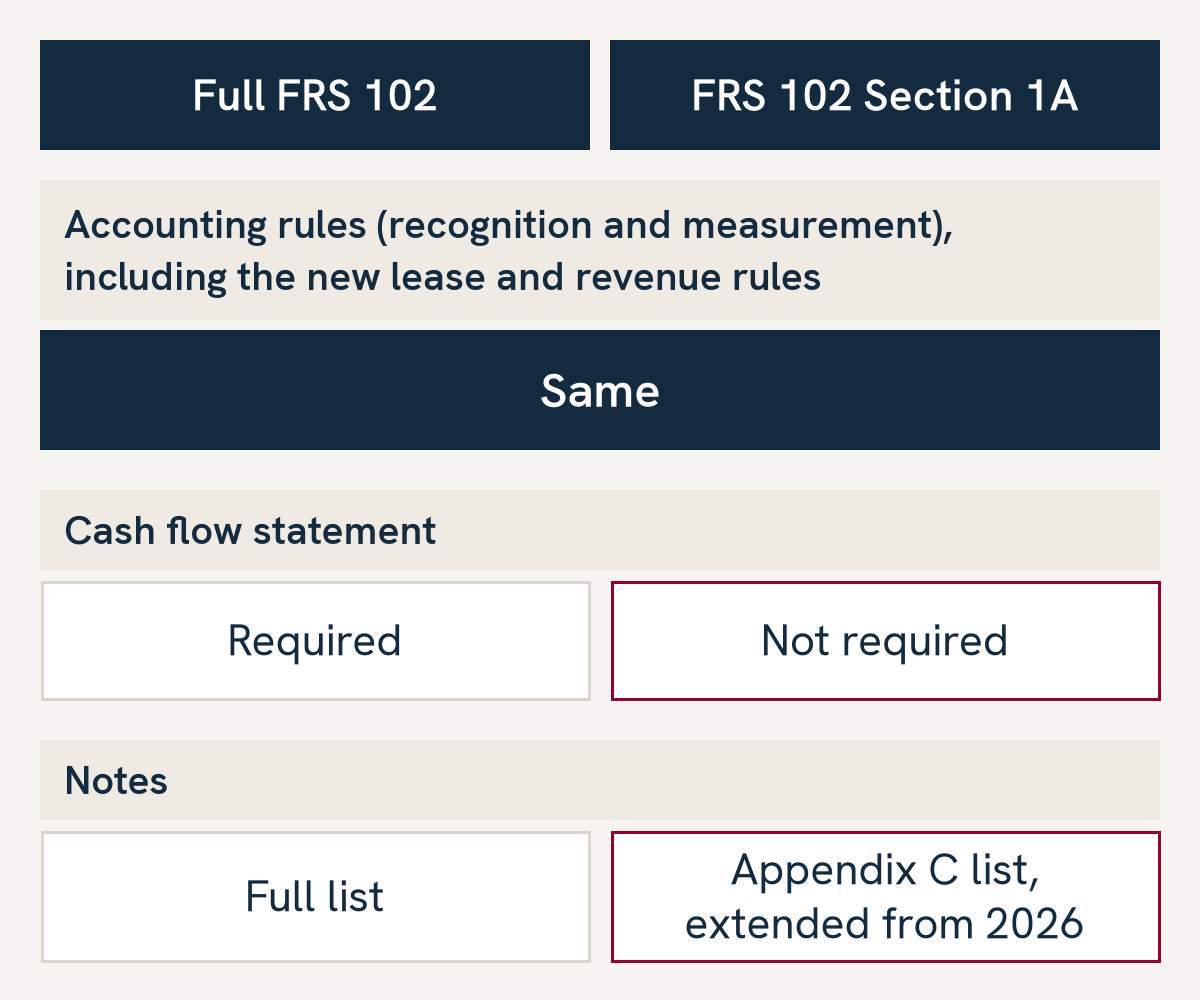
FRS 102 Section 1A is the small company regime inside FRS 102. Small companies follow the same accounting rules as everyone else but give fewer notes, and from your first accounts under the new rules that includes the new lease and revenue rules. The list of notes a small company must give has also grown. For the wider picture, see our FRS 102 guide.
Key points
- Section 1A cuts the notes, not the rules. Small companies apply the new lease and revenue rules in full for periods beginning on or after 1 January 2026.
- The notes a UK small company must give now include going concern, deferred tax, leases, provisions, related parties and dividends declared and paid.
- A small company still does not have to prepare a cash flow statement.
- Abridged and filleted accounts stay. The plan to make small companies file a profit and loss account was paused on 23 October 2026.
- From 1 April 2028, all companies must file their accounts at Companies House using commercial software.
What is FRS 102 Section 1A?
Section 1A is the part of FRS 102, the Financial Reporting Standard applicable in the UK and Republic of Ireland, written for small entities. It lets a small company present and disclose less, but the recognition and measurement rules are the same as for any other company using FRS 102. Ask us which of the new notes your company will need.
Recognition and measurement decide what goes into the accounts and at what figure. Presentation and disclosure requirements decide the layout and the notes in the financial statements. Section 1A only changes the second.
A company is small if it meets two of three size tests: turnover, balance sheet total and average number of employees. The limits rose for financial years beginning on or after 6 April 2025. Our guide to the size limits from April 2025 sets them out, and the “which standard am I on?” table in our FRS 102 overview shows where your company sits.
Section 1A is not the micro-entity standard. Most micro-entities use FRS 105, a separate and simpler standard. A micro-entity can choose Section 1A instead, but then it takes on all of FRS 102, including the new lease rules.
Do small companies have to follow the new lease and revenue rules?
Yes. The new rules on leases (Section 20) and revenue (Section 23) apply to small companies in full. Paragraph 1A.1 of the standard puts it plainly: “Unless excluded below, all of the requirements of this FRS apply to a small entity, including the recognition and measurement requirements.”
For leases, most leases now come onto the balance sheet. The company shows a right-of-use asset (the right to use the property or vehicle, shown as an asset) and a lease liability (the payments still due, discounted to today’s value). Leases with a lease term of 12 months or less, and leases of low-value assets, can stay off. FRS 102 sets no £ limit for low value, and cars and vans never qualify. Our guide to the new lease rules works through an example.
For revenue, one five-step model now applies to every customer contract. The FRC says the effect “depends on its particular business model and contracts”. Our guide to the five-step revenue model gives examples by type of business.
Fewer notes, same numbers
Being small does not exempt you from the lease or revenue changes. If your accounts are prepared under Section 1A, your premises and vehicle leases are likely to appear on your balance sheet in your first accounts under the new rules.
What new disclosures does Section 1A require from 2026?
The FRC has expanded Appendix C to Section 1A, the list of notes a UK small company must give in its financial statements. After Brexit, the FRC was able to set out the disclosures it considers necessary for small company financial statements to give a true and fair view (the legal test that accounts give a fair picture of the company).
The FRC expects the notes many small companies give may not change much. The aim is less judgement about what to include.
| Disclosure | Paragraph | What it means for an owner-managed company |
|---|---|---|
| Statement of compliance | 1AC.2A | A statement that the accounts are prepared under FRS 102. |
| Going concern | 1AC.2C | A note on the basis that the company will carry on trading (see FRC Factsheet 13). |
| Deferred tax, with current tax | 1AC.11A, 1AC.32C | Tax on items taxed in a different year from the one they hit the accounts, shown alongside the current tax charge. |
| Significant leasing arrangements | 1AC.31A, 1AC.31B | “A general description of its significant leasing arrangements”: typically your premises, vehicles and equipment. |
| Short-term, low-value and variable lease payments | 1AC.32A | Payments on short-term and low-value leases kept off the balance sheet, and variable lease payments, get a note. |
| Provisions and contingencies | 1AC.31C | Costs the company has provided for, and possible liabilities that may or may not arise. |
| Share-based payments | 1AC.31D | Only relevant if the company rewards staff or directors with shares or share options. |
| Performance obligations | 1AC.32B | A description of what the company promises its customers, linked to the new revenue model. |
| Related parties | 1AC.35 (by reference to 33.9 and 33.14) | Transactions with people closely connected to the company, such as directors (see below). |
| Dividends declared and paid | 1AC.40 | The dividends declared and paid in the year are shown in a note. |
| First-time adoption of FRS 102 (not the 2026 changes) | 1AC.41 | For a company adopting FRS 102 for the first time, an explanation of how the move affected its financial position and performance. |
Do small companies disclose directors’ pay and related party transactions?
FRS 102 has no explicit requirement for a UK small company to disclose directors’ pay. Related party transactions, on the other hand, are on the Section 1A list.
Directors’ remuneration
The full standard’s note on key management pay (paragraph 33.7) is excluded for small companies. In the FRC’s words, “there is no explicit requirement in FRS 102 for a UK small entity to disclose directors’ remuneration.” The FRC adds two qualifications: the law still requires disclosure of directors’ remuneration that is not on normal market terms, and a true and fair view may call for more.
Premises owned by a director
Some owner-managed companies rent premises from a director, or from the director’s pension scheme. In most cases we would expect two things. The lease comes onto the balance sheet like any other lease. The rent is also likely to be a related party transaction that needs a note. Check with us before relying on this for your own arrangement.
Director’s loans
A loan between the company and a director is a related party transaction. In most cases we would expect a director’s loan account to need a note. Check with us before relying on this for your own balance.
What does the dividends note mean if you pay yourself by dividend?
Small company accounts must now disclose the dividends declared and paid in the year (paragraph 1AC.40). If you take much of your income as dividends, the total will appear in the notes.
The note is a disclosure. It does not change whether the company can pay a dividend. That depends on distributable reserves (the profits available to pay out), which the new lease rules can affect in the first year. We cover that in our guide to dividends, reserves and bank covenants. Whether the dividend figure reaches the public record depends on what you file (see below).
What stays the same for small companies?
A small company using Section 1A still does not have to prepare a cash flow statement (paragraph 1A.7A). Two other parts of the package will pass most small companies by.
- Cash flow statement. Under the new lease rules, the capital part of lease payments moves to financing cash flows. That presentation change mostly matters to medium and large companies, because a small company need not prepare the statement.
- Supplier finance. New disclosures on supplier finance arrangements (where a finance provider pays suppliers on the company’s behalf) sit in the cash flow section of FRS 102, which a Section 1A company does not have to apply. So in most cases we would expect a small company not to need them. A true and fair view could still call for disclosure of a material arrangement, so check with us before relying on this.
What do small companies file at Companies House, now and from April 2028?
Small companies can still file abridged accounts (a shortened form of the accounts) or filleted accounts (where no profit and loss account is filed). On 23 October 2026 the government paused the plan to make small companies and micro-entities file a profit and loss account.
If you have read that abridged accounts are going, that was the 2024 plan under the Economic Crime and Corporate Transparency Act 2023. It has been overtaken: both options remain available after 1 April 2028.
What changes from 1 April 2028
- Software-only filing. All companies must file their accounts in iXBRL (a tagged digital format) using commercial software. Web and paper filing of accounts closes, with no transition period. Web filing stays for other filings, such as the confirmation statement. Official wording differs on late filings, so treat anything filed on or after 1 April 2028 as needing software.
- A stronger audit exemption statement. A small company is normally exempt from audit (see audit exemption thresholds). From April 2028, directors claiming an exemption must say which one they are claiming and confirm the company qualifies for it.
Separately, the government has said it intends to remove the requirement for any company to produce a directors’ report. That is a proposal only, and no regulations have been made.
Will the new lease figures appear on the public record?
We would expect a small company filing abridged or filleted accounts to show its new right-of-use assets and lease liabilities on the filed balance sheet, but not the profit and loss effects. Which notes are filed, including the new lease and dividend notes, is likely to depend on the filing option you use. Check with us before relying on this.
The deadline itself has not changed: a private company files nine months after its year end. For a year ending 31 December 2026, the first under the new rules for most December companies, that is 30 September 2027.
What should you do now?
Start gathering what the new notes and lease rules need before your year end.
- List every lease: premises, vehicles and equipment, with the payments and the years left. Mark any lease from a director or a director’s pension scheme.
- Look at customer contracts with bundles, upfront fees, stage payments or bonuses, where the revenue rules are most likely to bite.
- Check your size with the lease assets added to the balance sheet total.
- Keep a clear record of dividends declared and paid, and of transactions and balances with directors.
- Before an interim dividend in your first year under the new rules, check reserves with us.
- Make sure whoever files your accounts can file in iXBRL through software before 1 April 2028.
Questions clients ask
Can a micro-entity use Section 1A instead of FRS 105?
Yes. The micro-entity regime is optional, and a company that qualifies can choose FRS 102 with Section 1A instead. It then applies FRS 102 in full, including the new lease rules. Under FRS 105, leases stay off the balance sheet. Our comparison of micro-entity accounts covers the choice.
Our year ends on 31 March 2027. Do the new rules apply?
Yes. That year begins on 1 April 2026, after the 1 January 2026 start date, so it is your first year under the new rules unless you adopted early. The FRC’s own example gives 1 April 2026 as the date of initial application. For a 12-month period, the accounts are due at Companies House by 31 December 2027.
Do we have to restate last year’s figures?
Not for leases: a lessee does not restate comparatives, and the prior year stays on the old basis. For revenue there is a choice. You can restate in full, or take the cumulative effect to opening retained earnings for contracts not completed at the date of initial application.
Could putting leases on the balance sheet stop us being small?
It could for a company close to the £7.5 million balance sheet limit, because right-of-use assets add to total assets. In most cases we would expect the effect to be softened: a company must exceed two of the three limits, and a change of size usually counts only after two years in a row. Check your own figures with us before relying on this.
Speak to us. If you want your first Section 1A accounts under the new rules prepared with the right notes and the right filing option, Jack Ross, independent chartered accountants in Manchester, can help through our accounts preparation and support: call us on 0161 832 4451 or send us a message.
More in our FRS 102 guide
- The 2026 FRS 102 changes explained
- Leases on the balance sheet, with a worked example
- The five-step revenue model for owner-managed businesses
- Micro-entity accounts: FRS 105 or FRS 102?
- Company size limits from April 2025
- EBITDA, bank covenants, dividends and tax
Sources
- FRC: FRS 102, the standard and its amendments
- FRC: FRS 102 explainer, summary of the Periodic Review 2024 changes (June 2026)
- FRC: Factsheet 9, initial application of the Periodic Review 2024 amendments
- FRC: Factsheet 13, going concern for small companies and micro-entities
- FRC: FRS 105, the micro-entities regime
- GOV.UK: Companies House update to accounts filing from April 2028 (23 October 2026)
- GOV.UK: Changes to UK company law, changes to accounts
- Companies House: using software to file your company’s information
- Companies Act 2006, section 382: the small company test