
Stated as at 18 November 2026. The amended FRS 105 and FRS 102 are now in force for accounting periods beginning on or after 1 January 2026. Take advice on your own circumstances before acting.
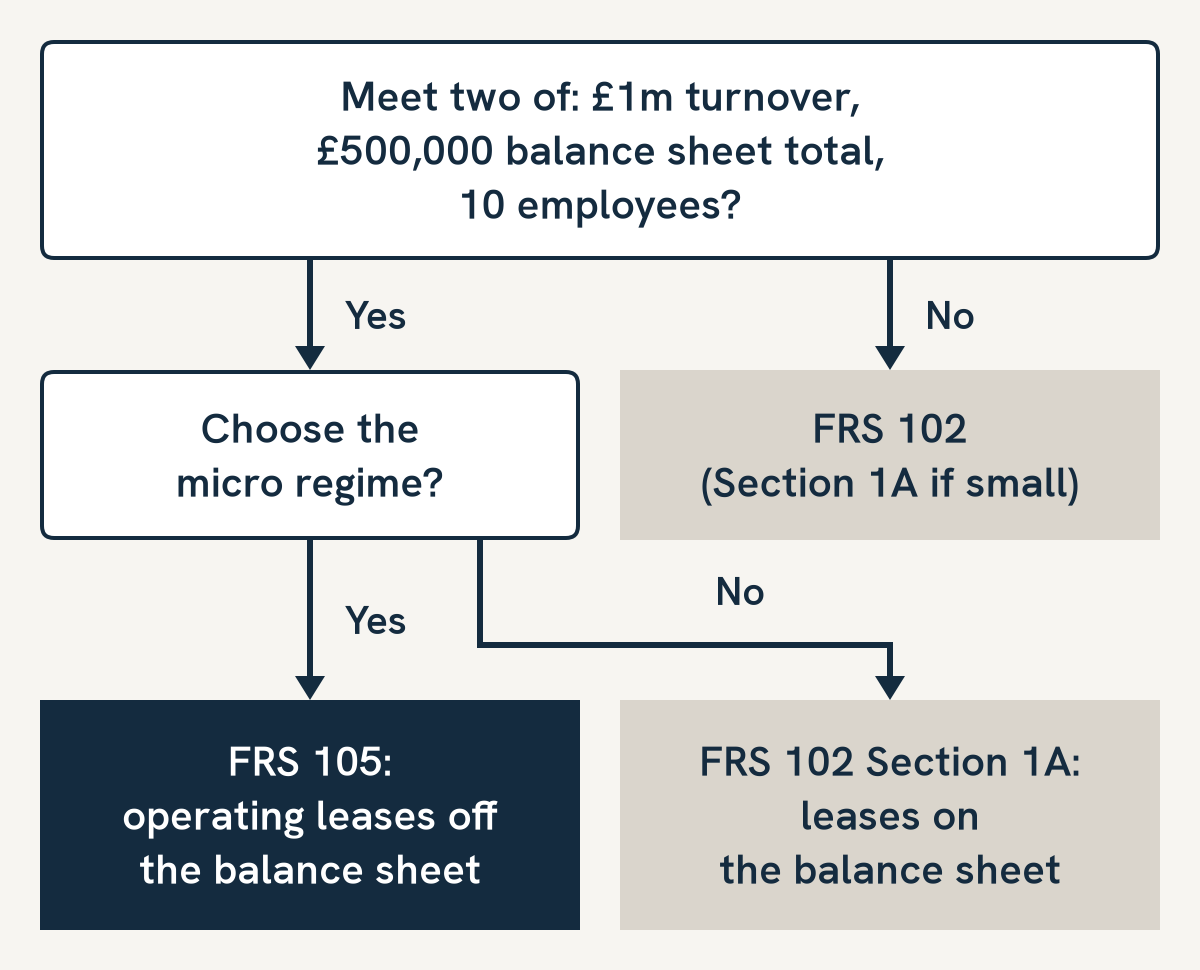
FRS 105 is the UK accounting standard for micro-entities, and part of UK GAAP alongside FRS 102. These are companies that meet at least two of three tests: a turnover of £1 million or less, a balance sheet total (total assets) of £500,000 or less, and 10 employees or fewer. Using it is optional, so a micro company can choose FRS 102, the Financial Reporting Standard applicable in the UK and Republic of Ireland, instead, usually with the small company rules in Section 1A. Both changed from 1 January 2026. Under FRS 105 leases are unchanged, but a simpler revenue model applies to new contracts. For how the standards fit together, see our FRS 102 guide.
Key points
- A company is a micro-entity if it meets two of three limits: £1 million turnover, £500,000 balance sheet total and 10 employees, for financial years beginning on or after 6 April 2025.
- FRS 105 was amended for accounting periods beginning on or after 1 January 2026. For a 12-month year to 31 December, your first accounts under the new rules are usually for the year to 31 December 2026.
- FRS 105 lease rules did not change: operating leases stay off the balance sheet.
- FRS 105 now has a simplified five-step revenue model. It applies only to contracts that begin after the change; contracts already in progress keep the old treatment.
What is FRS 105?
FRS 105 is the Financial Reporting Standard applicable to the Micro-entities Regime. It is one of the UK accounting standards set by the Financial Reporting Council (FRC), and it sets the rules for the accounts of the smallest companies.
The micro-entities regime is a choice, not an obligation. A company that qualifies but chooses not to use it must apply another standard. For most micro companies that is FRS 102, with the reduced disclosure of Section 1A for small companies. Section 1A is part of FRS 102, not the micro-entity standard.
Is FRS 105 still valid? Yes. The FRC amended it in its Periodic Review 2024, completed in March 2024, with an effective date of 1 January 2026.
Who can use FRS 105? The micro-entity limits
A company is a micro-entity if it meets at least two of these three limits. Turnover alone does not decide it.
- Turnover: not more than £1 million.
- Balance sheet total (the total of the assets on the balance sheet): not more than £500,000.
- Average number of employees: not more than 10.
These limits apply to financial years beginning on or after 6 April 2025. Before that, the micro limits were £632,000 of turnover and a £316,000 balance sheet total, so some companies that were too big before may now qualify. When working out your size for a year beginning on or after 6 April 2025, earlier years are judged against the new limits too.
The size rules have some fine print, set out in our guide to how the size tests work. Our hub has a table of which standard each size of company uses. Before you rely on the micro regime, ask us to confirm that your company can use it.
What changed in FRS 105 from 1 January 2026?
Revenue changed, and the standard’s concepts section was rewritten. Leases did not change. The amendments apply to accounting periods beginning on or after 1 January 2026.
For a 12-month year with no early adoption, the first year under the new rules ends on 31 December 2026 for a December year end, or 31 March 2027 for a March year end.
Revenue: a simplified five-step model, for new contracts only
FRS 105 has a new Section 18 on revenue. It is a further simplified version of the five-step model now in FRS 102 Section 23, which recognises revenue as you deliver what you promised the customer.
The new model applies only to contracts that begin after you first apply it. Contracts in progress at that date keep your existing accounting policy. Our guide to the five steps explained covers the full FRS 102 version.
Leases: no change
The FRC made no amendments to FRS 105 Section 15, Leases. A micro-entity keeps its operating leases off the balance sheet. The FRC judged that the costs would far exceed the benefits for micro-entities, and may look at this again later.
Section 2 and inventories
Section 2, the concepts the standard is built on, now follows the new FRS 102 Section 2 in shortened form; the FRC expects little change in practice. A minor February 2026 clarification to Section 10 (inventories, meaning stock) is part of the same package.
FRS 105 vs FRS 102: what is the difference?
The biggest difference since 2026 is leases. Under FRS 102, including Section 1A for small companies, most leases now sit on the balance sheet. Under FRS 105, operating leases stay off it.
| FRS 105 (micro-entities) | FRS 102 with Section 1A (small companies) | |
|---|---|---|
| Who can use it | Companies meeting two of: £1m turnover, £500,000 balance sheet total, 10 employees. Optional. | Small companies, including micro companies that choose not to use FRS 105 |
| Operating leases | Stay off the balance sheet (Section 15 not amended) | Most come onto the balance sheet as a right-of-use asset and a lease liability |
| Lease cost in the profit and loss account | No change (Section 15 not amended) | Depreciation of the asset plus interest on the liability |
| Revenue | Simplified five-step model (Section 18) | Full five-step model (Section 23) |
| Contracts in progress when the new rules start | Keep the old policy | Brought into the new model, either for contracts not yet completed or by restating the comparative year |
| Profit and loss account filed at Companies House | Not required for now (requirement paused 23 October 2026) | Not required for now (requirement paused 23 October 2026) |
Small companies on Section 1A apply the new lease and revenue rules in full. Section 1A only cuts down presentation and disclosure. From 2026 it also lists notes UK small companies give, including going concern, deferred tax, leasing arrangements, provisions, dividends and related parties. Our guide to the small company rules goes through each one.
When might FRS 102 suit a micro company better?
For many micro companies FRS 105 is likely to remain the natural choice. In two situations FRS 102 with Section 1A may suit better. It is a judgement for each company, so check with us before relying on these points.
Your bank or an investor wants the fuller picture
FRS 102 accounts show your leases on the balance sheet and carry the Section 1A notes on going concern, leases, dividends and related parties. A lender or investor who wants that information may prefer them. If yours has asked, talk to us before your year end.
You expect to grow past the micro limits
A company that outgrows the micro limits has to apply another standard. If you expect that soon, moving at a time you choose may be less disruptive than moving at short notice. We would weigh that against the extra work in the meantime.
What moving involves
Moving to FRS 102 is likely to mean more work at year end. Expect to:
- list every lease and its terms;
- choose a discount rate for each one (the interest rate used to bring future payments to today’s value);
- apply the full revenue model;
- give the Section 1A notes.
Leases on the balance sheet add a liability, and the FRC warns that gearing (borrowing compared with equity), interest cover, the current ratio and EBITDA (profit before interest, tax, depreciation and amortisation) may all change. Our guide to the effect on EBITDA, covenants and tax covers this.
What happens if you grow out of micro or choose FRS 102?
You must apply another standard, which for most companies is FRS 102, usually with Section 1A. The new lease and revenue rules then apply to you in full, whether you outgrow the limits or leave the micro regime by choice.
Most leases come onto the balance sheet. You show a right-of-use asset (the right to use the property or vehicle, shown as an asset) and a lease liability (the payments still due, discounted to today’s value). In the profit and loss account, rent is replaced by depreciation of the asset and interest on the liability. Total cash paid is the same.
Two exemptions keep some leases off the balance sheet:
- Short-term leases: a lease term of 12 months or less at the start, with no purchase option.
- Low-value assets: items such as laptops, tablets and phones. FRS 102 sets no £ limit. Cars, vans, lorries and buildings are never low value.
A hypothetical example shows how FRS 102 measures a lease. Three vans are leased for £21,600 a year in total, with three years of payments made yearly in arrears, and 7% is an illustrative rate from a bank quote. The lease liability is the present value of those payments: £56,685. With no other costs, the right-of-use asset starts at the same amount. In the first year the profit and loss account shows depreciation of £18,895 and interest of £3,968 in place of £21,600 of rent. Our guide to how the new lease rules work has a fuller example.
For corporation tax, HMRC’s manual says that in most cases the depreciation and interest on a lease of this kind are deductible in place of rent (the long funding lease rules still apply). If you are moving from FRS 105, ask us how your first FRS 102 accounts, including the starting figures and last year’s comparatives, would be prepared.
Micro-entity accounts: what do you file at Companies House?
For now, micro companies do not have to file a profit and loss account. On 23 October 2026 the government paused the plan to make small companies and micro-entities file one. Abridged accounts (a shortened version), and filleted accounts (filed without the profit and loss account), remain available.
Two dates matter:
- Filing deadline: a private company files its accounts within nine months of its year end. For a 12-month year with no early adoption, the first accounts under the new rules are due by 30 September 2027 (31 December 2026 year end) or 31 December 2027 (31 March 2027 year end).
- Software-only filing from 1 April 2028: all companies must then file accounts in iXBRL (a tagged digital format) using commercial software. Web and paper filing of accounts closes. To be safe, treat anything you file on or after 1 April 2028 as needing software.
What should a micro company do now?
Check your size, decide on your standard, and list the contracts that started this year:
- Check your size against the current limits (two of the three tests), using this year’s and last year’s figures.
- Decide between FRS 105 and FRS 102 before your first accounts under the new rules are prepared.
- List customer contracts that began in the year. These are the ones the new FRS 105 revenue model applies to.
- If you are moving to FRS 102, gather your lease documents: the term, the payments, any break clauses or options, and a borrowing rate quote from your bank.
- Check your accounts software can file in iXBRL before 1 April 2028.
Questions clients ask
Does a micro company have to use FRS 105?
No. The micro-entities regime is optional. A company that qualifies but chooses not to use it must apply another standard, which for most is FRS 102 with Section 1A. That brings the new lease and revenue rules with it.
When did the micro-entity thresholds change?
For financial years beginning on or after 6 April 2025. The limits rose to £1 million of turnover and a £500,000 balance sheet total, from £632,000 and £316,000, with the employee limit at 10. A company needs to meet two of the three.
Do micro-entities have to put leases on the balance sheet from 2026?
Not under FRS 105. The FRC did not amend its lease section, so operating leases stay off the balance sheet. A micro company that uses FRS 102 instead must bring most leases on.
Can we adopt the 2026 FRS 105 changes early?
Yes, but only by applying all of the amendments at the same time; you cannot pick one part. The changes are in force anyway for accounting periods beginning on or after 1 January 2026.
Speak to us. If you are weighing up FRS 105 against FRS 102 for your company, we can go through the choice with you before your year end. Call us on 0161 832 4451 or send us a message. You can also read about our accounts and accounting support.
More in our FRS 102 guide
- FRS 102: the 2026 changes explained
- Lease accounting changes for small and medium-sized companies
- The five-step revenue model for owner-managed businesses
- What changes for small companies under Section 1A
- Company size limits from April 2025
- EBITDA, bank covenants, dividends and tax
Sources
- FRC: FRS 105, the Financial Reporting Standard applicable to the Micro-entities Regime
- FRC: FRS 102 and its amendments
- FRC: FRS 102 explainer for users of accounts (June 2026)
- FRC staff: Factsheet 11, Lease accounting for lessees (November 2024)
- legislation.gov.uk: The Companies (Accounts and Reports) (Amendment and Transitional Provision) Regulations 2024, SI 2024/1303
- GOV.UK: Companies House update to accounts filing from April 2028 (23 October 2026)
- Companies House: Using software to file your company’s information
- HMRC Business Leasing Manual: BLM51005