

Stated as at 18 November 2026. The new revenue rules in FRS 102 Section 23 are now in force for accounting periods beginning on or after 1 January 2026. Take advice on your own circumstances before acting.
FRS 102 revenue recognition now follows one five-step model, set out in a new Section 23 that applies to accounting periods beginning on or after 1 January 2026. It decides when your turnover goes into the accounts, and how much. For leases and the other changes, see our FRS 102 guide.
Key points
- The new Section 23 is now in force. With a 31 December year end and no early adoption, your first accounts under the new rules are for the year ending 31 December 2026.
- Small companies on Section 1A apply it in full. Micro-entities on FRS 105 get a simpler model for new contracts only.
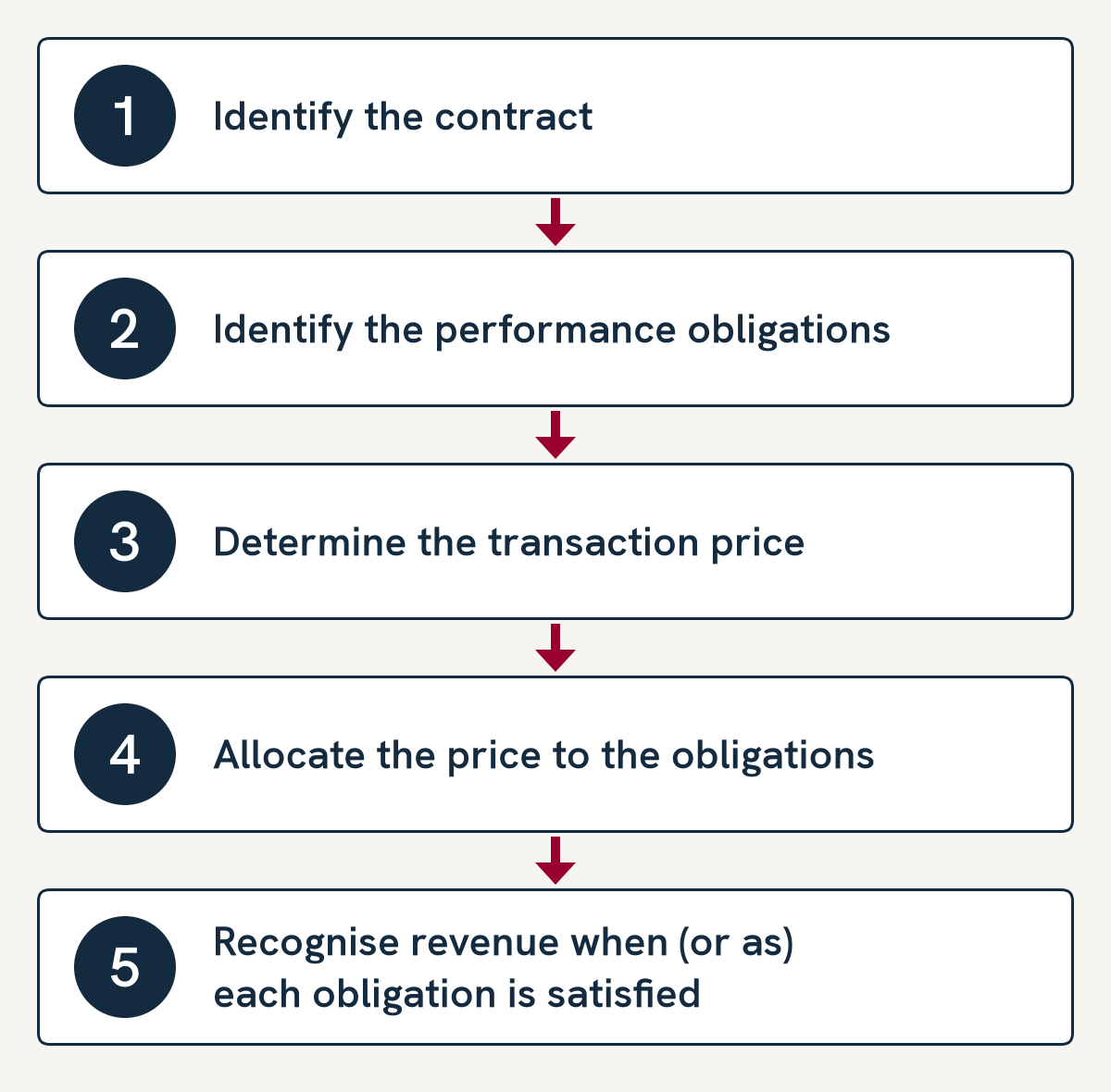
- Five steps: identify the contract, identify the performance obligations (the separate promises to the customer), determine the transaction price, allocate it, recognise revenue.
- We would expect most change where you sell bundles or warranties, charge upfront fees, or earn bonuses or stage payments. Simple sales of goods may see little difference.
- Unlike leases, you can choose whether to restate last year’s revenue.
What is FRS 102 revenue recognition, and what has changed?
A revised Section 23 replaces the old one, which was based on two international standards, IAS 11 and IAS 18. The new section is based on IFRS 15, the international standard on revenue, with simplifications. If you are not sure which of your contracts will move, ask us to look at them.
The new section applies one revenue recognition model to every contract with a customer. Whatever you sell, you work through the same five steps.
The FRC (Financial Reporting Council) published the change in March 2024 as part of its Periodic Review 2024 of FRS 102, the Financial Reporting Standard applicable in the UK and Republic of Ireland.
Does the new Section 23 apply to my company, and when?
If your company prepares accounts under FRS 102, yes, including small companies using Section 1A.
Small companies are not exempt
Section 1A reduces what a small company must present and disclose, not how revenue is measured or recognised. A small company applies the new Section 23 in full, and its notes must now cover performance obligations in customer contracts.
The date that matters is the start of your accounting period, not the year end. For a 12-month period with no early adoption, it works like this:
- year ending 31 December 2026: the first year on the new rules, with accounts due at Companies House by 30 September 2027;
- year ending 31 March 2027: the first year on the new rules, with accounts due by 31 December 2027.
Micro-entities on FRS 105 have their own simpler model (see the questions below and our guide for micro-entities).
What are the five steps?
Identify the contract, identify the performance obligations, determine the transaction price, allocate it, then recognise revenue when (or as) each obligation is satisfied. You work through them in order, contract by contract.
Step 1: identify the contract
A contract counts only when five tests are met. Both sides have approved it and are committed, each side’s rights and the payment terms can be identified, it has commercial substance, and payment is probable. Until then, money received is a liability.
Everyday illustration: a signed quote with agreed price and payment terms.
Step 2: identify the performance obligations
A performance obligation is a promise to deliver a distinct good or service. Distinct means the customer can benefit from it on its own (or with things readily available), and the promise is separate from the others. Anything you regularly sell separately passes the first test.
Everyday illustration: a supply-and-fit job may hold two promises if you also sell the goods and the fitting on their own.
Step 3: determine the transaction price
The transaction price is what you expect to be paid. Bonuses, rebates and discounts make it variable. You estimate them, as an expected value or the most likely amount, and include them only to the extent it is highly probable the revenue will not later reverse.
Everyday illustration: a fixed fee plus a bonus for hitting a deadline.
Step 4: allocate the price to the obligations
Where a contract holds more than one promise, the price is shared in proportion to what each sells for on its own (its stand-alone price).
Everyday illustration: a package discount is spread across every item in it.
Step 5: recognise revenue when (or as) each obligation is satisfied
Revenue is recognised over time as you do the work, or at the point control passes to the customer.
Everyday illustration: a cleaning service is recognised over time, because the customer benefits as the cleaning is done.
How do the five steps work in practice?
Three FRC staff illustrations from the revenue factsheet, restated in pounds. They are hypothetical, not client figures.
A service contract with a bonus
Hypothetical, based on FRC Factsheet 10, Example 2. A business agrees a fixed fee of £50,000, plus a bonus of £25,000 if agreed targets are met. The work is delivered over time, and the job is 90% complete at the year end.
Revenue follows progress on the work. The £25,000 bonus is variable consideration (the part of the price that can move), included only to the extent it is highly probable the revenue will not later reverse. If the targets are in doubt at the year end, part or all of it stays out.
Paid in advance, delivered over time
Hypothetical, based on FRC Factsheet 10, Example 4. A customer pays £10,000 up front for work delivered over time. On receipt, the whole £10,000 is a contract liability: money received for work not yet done, shown as a liability.
When the work is 60% done, £6,000 moves to revenue and £4,000 stays as a contract liability. Where you have earned more than you have billed, the difference is a contract asset (Example 5).
A bundle sold at a discount
Hypothetical, based on FRC Factsheet 10, Example 3. Three items sell on their own for £4,000, £8,000 and £5,000, which is £17,000 in total. A customer buys all three together for £15,000.
The £2,000 discount is spread across all three items in proportion to their stand-alone prices.
When is revenue recognised on fixed-price jobs and stage payments?
Over time, if the job meets any one of the three tests below. Otherwise, when control passes to the customer.
- the customer receives and uses the benefit as you do the work;
- your work creates or improves an asset the customer controls;
- what you are making has no alternative use to you, and you have an enforceable right to be paid for the work done to date.
The third test turns on your contract wording. If a customer can walk away without paying for work done so far, the job may fail it, and unless another test is met, revenue waits until control passes.
Stage payments and invoice dates do not in themselves decide revenue. In most cases we would expect revenue to follow the work, with the gap between billed and earned shown as a contract asset or liability.
What about bonuses, retentions, upfront fees and subscriptions?
Bonuses, rebates and discounts follow step 3 and the first example above. The items below need more judgement, and the answer depends on the contract terms.
Retentions
The FRC’s material does not deal with retentions by name. Where part of a retention may never be paid, for example if defects are not put right, we would expect it to be treated like other variable consideration. Check with us before relying on this.
Upfront fees
Commentary hosted by ICAEW names non-refundable upfront fees, bundles and warranties as likely pressure points. If you charge a joining or set-up fee, do not assume your current treatment still holds; check with us before your first accounts under the new rules.
Subscriptions
Where a customer uses your service as you provide it, such as access to software, revenue is likely to be recognised over the subscription period under the first over-time test. We have found no FRC example on this, so take advice on your own terms.
Will my revenue figure actually change?
It depends on your contracts: the FRC says the effect turns on each business model and its contracts.
If you sell goods at the till or on delivery, for a fixed price, with one promise per sale, we would expect little change in most cases. Confirm this with us rather than assume it: one warranty, rebate or bundle in your terms can change the picture.
Do we have to restate last year’s revenue?
No, unless you choose to. For revenue, FRS 102 offers two ways in. Both turn on the date of initial application: the first day of the first period on the new rules (1 January 2026 for a 31 December year end).
| Approach | Which contracts | Last year’s figures |
|---|---|---|
| Modified retrospective | Contracts not completed at the date of initial application | Not restated. The cumulative effect goes to opening retained earnings. |
| Full retrospective | All contracts, with relief for some already completed | Restated. For a 31 December 2026 year end, the 2025 figures are restated. |
The modified approach is not limited to new contracts. It covers every contract still running at the date of initial application, such as a job started in 2025 and unfinished on 1 January 2026.
A 31 December 2026 year end restating in full needs a restated position at 1 January 2025, though that balance sheet is not shown. Contracts completed before 1 January 2025 need no restatement, and some practical reliefs apply.
Leases differ: a tenant cannot restate last year at all (see our lease guide). An adjustment to opening retained earnings may also affect the reserves you pay dividends from; see what the changes mean for tax, covenants and dividends.
How is a revenue transition adjustment taxed?
Probably in one go, in your first period on the new basis. This is our reading of existing law: HMRC has published nothing specific on the new Section 23, and its revenue guidance still describes the old one.
Moving to the new Section 23 is a change of accounting policy, so the change of basis rules in the Corporation Tax Act 2009 are likely to apply. They treat a net adjustment as arising on the first day of the first period on the new basis. We have found no special spreading rule for revenue.
Have a tax adviser confirm this for your contract balances before relying on it. Our guide to the business impact of the changes covers corporation tax in more detail.
What should I do now?
Start with your contracts.
- List customer contracts that include bundles, stage payments, bonuses, rebates, retentions, warranties or upfront fees.
- For each, compare when you invoice with when you actually deliver.
- Check whether your contracts give you a right to be paid for work done to date if the customer cancels.
- Decide between the modified and full retrospective approaches before the year-end work starts.
- Talk to us about the tax timing and about any dividends planned in the first year.
If you are a small company, your notes will also change. See what changes for small company accounts.
Questions clients ask
Can we adopt the new revenue rules early without the lease rules?
No. FRS 102 allows early adoption only if a company applies all of the amendments at the same time, including the lease changes. A company that adopts early must say so in its accounts.
Do micro-entities have to use the five-step model?
Micro-entities using FRS 105 have a simpler version of the five-step model. They apply it only to contracts that begin after they first apply the new rules. Contracts already in progress at that date keep the old accounting.
What new revenue note will appear in small company accounts?
Small companies using Section 1A must now give information about the performance obligations in their customer contracts. We can help you draft the note from your main contract types.
Is the new Section 23 the same as IFRS 15?
It is based on IFRS 15, with simplifications. For example, FRS 102 words the limit on variable consideration differently, but the FRC says it has the same general effect as IFRS 15.
Speak to us. To have your contracts checked before your first accounts under the new rules, call us on 0161 832 4451 or send us a message. You can also read about our accounts and accounting support.
More in our FRS 102 guide
- FRS 102: the 2026 changes explained
- Leases on the balance sheet
- What changes for small companies
- Micro-entity accounts and the changes
- Company size limits from April 2025
- EBITDA, bank covenants, dividends and tax
Sources
- FRC: FRS 102 standard and amendments
- FRC staff: FRS 102 Factsheet 10, revenue from contracts with customers (November 2024)
- FRC staff: FRS 102 Factsheet 9, initial application of the amendments (re-issued May 2026)
- FRC: FRS 102 updates explainer (June 2026)
- FRC: FRS 105, the micro-entities standard
- legislation.gov.uk: Corporation Tax Act 2009, section 181 (change of basis)