Stated as at 18 November 2026. The size limits below apply to financial years beginning on or after 6 April 2025, and the new FRS 102 rules are now in force for accounting periods beginning on or after 1 January 2026. Take advice on your own circumstances before acting.
The small company thresholds for financial years beginning on or after 6 April 2025 are turnover of £15 million, a balance sheet total of £7.5 million and 50 employees. A company is small if it stays within at least two of the three. The limits rose by about 50%, so some companies that were medium-sized are likely to be small now. The new FRS 102 lease rules add to the balance sheet total, which can bring a company close to the £7.5 million line. For the wider changes, see our FRS 102 guide.
Key points
- Small: turnover £15 million, balance sheet total £7.5 million, 50 employees. Micro: £1 million, £500,000, 10. Medium: £54 million, £27 million, 250.
- You need to meet two of the three tests.
- A change of size only counts when it happens in two consecutive years.
- The balance sheet total is gross assets, so right-of-use assets from the new lease rules add to it.
- Micro-entities on FRS 105 keep their leases off the balance sheet, so the lease change does not affect their size.
What are the small company thresholds from April 2025?
For financial years beginning on or after 6 April 2025, a company is small if it meets two or more of these tests: turnover of not more than £15 million, a balance sheet total of not more than £7.5 million, and not more than 50 employees on average. The micro-entity thresholds and the medium-sized company limits work the same way.
| Size | Turnover | Balance sheet total | Average employees |
|---|---|---|---|
| Micro-entity | Not more than £1 million | Not more than £500,000 | Not more than 10 |
| Small | Not more than £15 million | Not more than £7.5 million | Not more than 50 |
| Medium-sized | Not more than £54 million | Not more than £27 million | Not more than 250 |
The balance sheet total is the total of all the assets on the balance sheet, with nothing taken off for liabilities. Employees means the average number employed during the year.
The old limits, for comparison
Older articles still quote the lower limits that applied before 6 April 2025, so check the date of anything you read.
| Limit | Before 6 April 2025 (superseded) | From 6 April 2025 |
|---|---|---|
| Small: turnover | £10.2 million | £15 million |
| Small: balance sheet total | £5.1 million | £7.5 million |
| Micro: turnover | £632,000 | £1 million |
| Micro: balance sheet total | £316,000 | £500,000 |
How does the two of three test work?
A company is in a size band when it meets at least two of the three tests, so being over one limit on its own does not change its size.
A company over two limits fails the small test for that year. Even then, its size does not change straight away.
When does a change of size take effect?
A company changes size only when it has met, or failed, the tests in two consecutive financial years (Companies Act 2006 s382(2)). One year over the limits does not make a small company medium-sized, and one year within them does not make a medium-sized company small.
The new limits are applied to earlier years too
When a company tests its size for a year beginning on or after 6 April 2025, it is treated as having met the new limits in earlier years if its figures for those years would have met them (SI 2024/1303 regulation 3). In practice, a company that fits the new limits should not have to wait a second year.
Example: December and March year ends
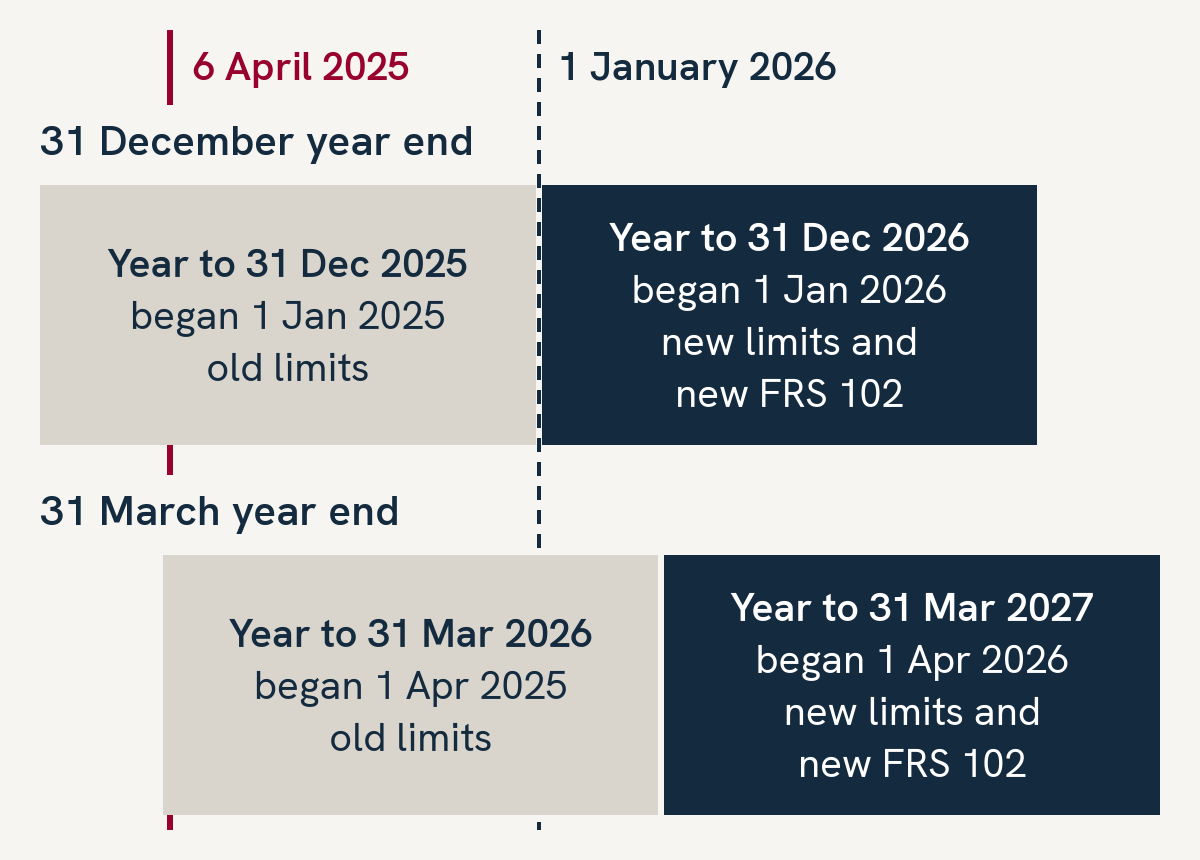
Hypothetical example. It assumes 12-month accounts to the same date for several years, not first accounts, and figures over the old small limits but within the new ones.
- 31 December year end. The year to 31 December 2025 began on 1 January 2025, before 6 April 2025, so the old limits apply to it. The year to 31 December 2026 is the first on the new limits. The 2025 figures are also tested against the new limits, so the company can be small for 2026 straight away.
- 31 March year end. The year to 31 March 2026 began on 1 April 2025, five days too early, so it still uses the old limits. The year to 31 March 2027 is the first on the new limits, and the transitional rule works in the same way.
The same years are also the first accounts under the new FRS 102 rules, so the new limits and the lease change land in the same accounts. A long or short period, early adoption or a new company’s first accounts can change these dates, so check with us if any apply.
What are the limits for a small group?
A group has its own small limits, tested on the combined (aggregate) figures of the companies in it. The turnover and balance sheet limits are each given net and gross.
| Test | Net | Gross |
|---|---|---|
| Aggregate turnover | Not more than £15 million | Not more than £18 million |
| Aggregate balance sheet total | Not more than £7.5 million | Not more than £9 million |
| Average employees | Not more than 50 | Not more than 50 |
How net and gross figures are worked out, and how the group test sits alongside each company’s own size, needs care. If your company owns subsidiaries or is owned by another company, ask us to check the group position.
What does your size decide for your accounts?
Your size band decides which accounting standard you can use. In short, micro-entities can use FRS 105, small companies can use Section 1A of FRS 102, and medium-sized and larger companies use full FRS 102. Our hub has a table showing which standard applies to you, set against the company size thresholds.
The micro-entity regime is optional. A company that qualifies but uses FRS 102, or grows past the micro limits, picks up the new lease rules. See choosing between the micro-entity standard and FRS 102.
Small companies using Section 1A get lighter disclosure, not lighter accounting: they apply the new lease and revenue rules in full. See what changes in Section 1A accounts.
Are small companies exempt from audit?
Yes, in most cases. The audit exemption thresholds follow the small company test: a company that qualifies as small for a financial year is exempt from audit (Companies Act 2006 s477). There are exceptions. Members can still require an audit, and some companies are excluded, including some in groups (s476, s478 and s479).
Because the exemption follows the small test, anything that changes your size can change your audit position, including the lease change below.
Can the lease change make your company too big to be small?
It can push the balance sheet total up, but in most cases we would expect it not to change a company’s size on its own. Under the new FRS 102, most leases come onto the balance sheet as a right-of-use asset (the right to use the property or vehicle, shown as an asset) and a lease liability (the payments still due, discounted to today’s value).
The balance sheet total is gross assets. The right-of-use assets add to it, and the lease liabilities are not deducted (Companies Act 2006 s382(5)). A company already near £7.5 million could cross the small limit. Micro-entities on FRS 105 are not affected: their leases stay off the balance sheet.
Worked example: a company close to £7.5 million
Hypothetical example. The assumptions:
- a balance sheet total of £7.2 million before the lease change, turnover of £12 million and 42 employees on average;
- a premises lease at £60,000 a year with 8 years left, and three vans leased at £21,600 a year in total with 3 years left;
- payments made yearly in arrears, discounted at 7%, an illustrative bank quote used as the obtainable borrowing rate (what the company would pay to borrow a similar sum over a similar term);
- no prepaid or accrued rent, so each right-of-use asset starts equal to its lease liability.
| Item | Amount |
|---|---|
| Balance sheet total before the lease change | £7,200,000 |
| Right-of-use asset: premises (£358,278 at the start, less a year’s depreciation) | £313,493 |
| Right-of-use asset: three vans (£56,685 at the start, less a year’s depreciation) | £37,790 |
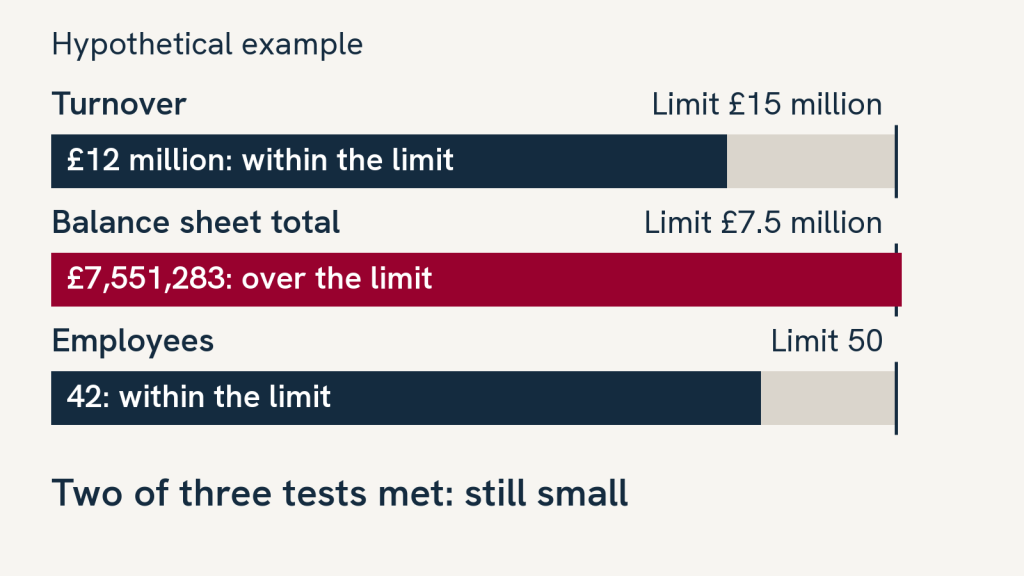
| Balance sheet total after the lease change | £7,551,283 |
| Small company limit | £7,500,000 |
The balance sheet total is now over £7.5 million, yet the company is still small. Turnover of £12 million and 42 employees are within their limits, so it meets two of the three tests.
Even if it were over a second limit, a single year over would not change its size: that takes two consecutive years. Our guide to the new lease rules shows how the lease figures are worked out.
Check your own figures before assuming anything
Whether the lease change tips a company over a limit depends on its own figures. Run the two of three test for this year and last year, with your leases included, before deciding your size has changed.
What do small and micro companies file at Companies House?
For now, small and micro companies can still choose not to file a profit and loss account: on 23 October 2026 the government paused the plan to make them. Abridged accounts, and filleted accounts (filed without the profit and loss account), remain available after 1 April 2028.
The government has announced these changes for April 2028:
- From 1 April 2028, all companies must file accounts using commercial software, in iXBRL (a tagged digital format). Web and paper accounts filing closes; treat anything filed on or after that date as needing software.
- Directors claiming audit exemption must name the exemption and confirm the company qualifies.
- The parts of the accounts are filed together.
- A company needs a business reason to shorten its accounting reference period (its financial year) more than once in five years.
Abridged and filleted accounts still include a balance sheet, so we would expect the new lease figures to appear on the public record. Our guide for small companies covers the filing options.
What should you do now?
Test your size, with the leases included, before your first accounts under the new rules are prepared.
- Gather turnover, balance sheet total and average employees for the current year and the year before.
- List your leases and estimate the right-of-use assets they will add.
- If the balance sheet total comes near £7.5 million, apply the two of three test and the two-year rule.
- If your company is part of a group, check the group limits as well.
- Before April 2028, confirm that your accounts software can file iXBRL accounts at Companies House.
Questions clients ask
Is the balance sheet total the same as net assets?
No. The balance sheet total is all the assets on the balance sheet, with no deduction for liabilities (Companies Act 2006 s382(5)). A company with large loans or lease liabilities can have modest net assets and a balance sheet total over £7.5 million.
Do the new limits apply to a 30 June year end yet?
Yes, assuming 12-month accounts. The year to 30 June 2026 began on 1 July 2025, after 6 April 2025, so it already uses the new limits. The year to 30 June 2027 is the first under the new FRS 102, when leases start to count towards the balance sheet total.
We are a micro-entity. Will the lease change affect our size?
Not while you use FRS 105. The FRC did not change the FRS 105 lease rules, so micro-entity leases stay off the balance sheet. If you move to FRS 102, or grow past the micro limits, your leases come onto the balance sheet and count towards the total.
Did the new FRS 102 change the size thresholds?
No. The limits are set by company law, in the Companies Act 2006 as amended by SI 2024/1303. The FRC amended FRS 102 and FRS 105 on 21 March 2025 so that the standards match the new limits for financial years beginning on or after 6 April 2025.
Speak to us. If your balance sheet total is near £7.5 million, we can run the size test on your own figures, with your leases included. Call us on 0161 832 4451 or send us a message. We are independent chartered accountants in Manchester; see our accounts and accounting support.
More in our FRS 102 guide
- The 2026 FRS 102 changes in one place
- Leases on the balance sheet
- Revenue and the five-step model
- What changes for small companies under Section 1A
- Micro-entity accounts: which standard to use
- EBITDA, bank covenants, dividends and tax
Sources
- The Companies (Accounts and Reports) (Amendment and Transitional Provision) Regulations 2024, SI 2024/1303, legislation.gov.uk, made 9 December 2024
- Companies Act 2006 s382: small companies
- Companies Act 2006 s383: small groups
- Companies Act 2006 s477: small companies and audit
- Amendments to FRS 102 and FRS 105: UK company size thresholds, FRC, 21 March 2025
- FRS 105 The Financial Reporting Standard applicable to the Micro-entities Regime, FRC
- Companies House update to accounts filing from April 2028, GOV.UK, 23 October 2026
- Using software to file your company’s information, Companies House, updated 25 September 2026
- Economic Crime and Corporate Transparency Act: company accounts factsheet, GOV.UK, updated 1 March 2024 (superseded; cited for the old limits only)